I bought this painting in the countryside in Cuba. It is a happy memory of Cuba that hangs over my bed 🙂
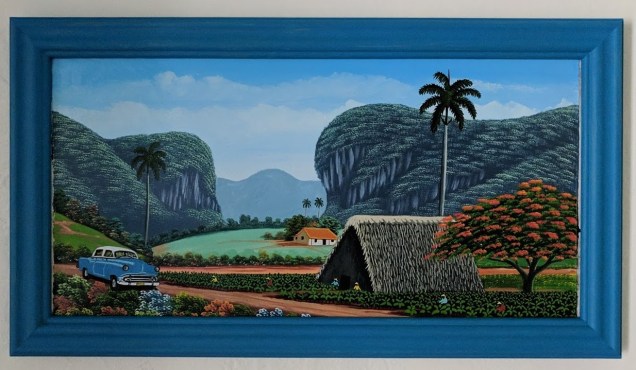
I think this is oil. Don’t you love the antique car?
When I travel, paintings are one of my favorite things to buy. You have supported a local artist who made something with his or her hands, and the piece has a story, and you have a wonderful memory. Everybody wins.
Cuba has a wonderful, rich cultural tradition: music, dance, and visual arts. For a country with 11.5 million people, it is amazing that they offer some of the best musicians, dancers, and artists in the world.
Outside of Havana, our tour van stopped at a home where we found several exhibition rooms. The couple who owns it provides classes for kids in the community, displaying some of their work as well as that of several adult artists in the town. This piece was about US$45. Every time I look at it it makes me happy. It is so vivid and cheerful. I experienced that a lot in Cuba: vividness and cheer. The Cuban people have made the best of some extremely difficult circumstances and they have a spirit that will endure in your mind long after your visit is over.
Tip #1: Art is light and easy to carry home. Lay it flat in your suitcase, preferably in brown paper wrapping, sandwiched between clothes, or roll up the canvas, also with paper around it. If the canvas is on stretchers, making it more awkward to carry, you can have the artist remove the stretchers. I did that with this one and rolled it up:
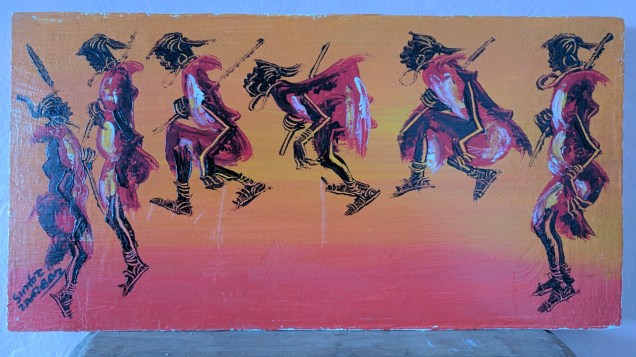
Acrylic on canvas Simba in Zanzibar 😀
Unfortunately, the paint that he used was either low quality or the canvas wasn’t sized (gessoed) or something. As you can see, there are a few faint white vertical lines from where the canvas was rolled and slightly crushed from the weight of my clothes. Some paint chipped off. Oh well. The piece was $20 and I still love it. It’s so full of energy.
Tip #2: About framing local art: the sizes are almost always *not* the standard sizes we use in the United States. This will make it more difficult to frame when you get back to wherever you live. I like to be thrifty. I will *not* spend $300+ framing something at home. No joke…
Once in Kenya, I bought a lovely little painting on thick paper of two Masai in reds and golds. It cost about US$7. I went to a framer in the basement of an art supply shop that I knew to be reasonably priced, at least their art supplies are. I picked out basic framing and matting. It was a small piece and I wanted the art to pop, not to be distracted by what surrounded it. Their price? $135. I took my $7 piece of paper and left.
It took me a few weeks, but I scoured antique and vintage shops around my city, Masai painting dimensions scribbled on a scrap of paper in my purse. I was lucky to find an old piece in a frame that was perfect and cheap, and the matting in it was also a good size. The problem? It was old. The matting was badly stained and had a small tear. Just a little effort and creativity goes a long way. And then in the end, you feel good about your work as well. I took a freshly brewed tea bag and after letting it cool, sort of “sponge painted” the mat. Spongy tea-colored stains hello, old water stains good-bye. You’ll see from the picture below how the tears look (upper left corner tear is barely visible, the lower left corner a bit more) after I taped up the back.
Voila!…
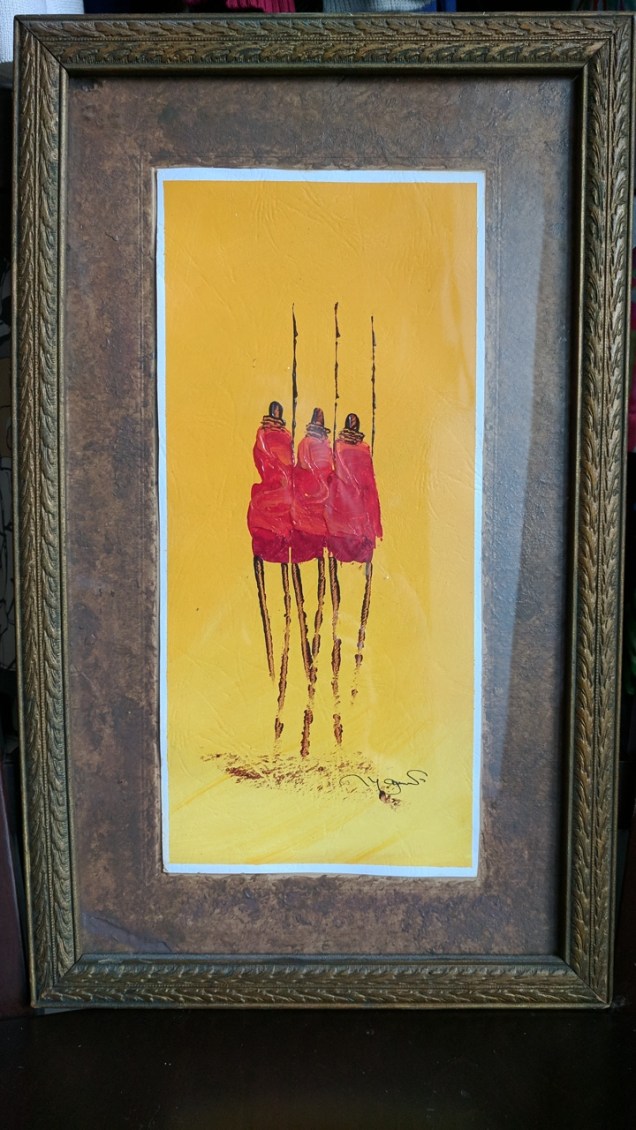
Masai in antique frame
It’s prettier in person, but I was not about to go removing the image from behind the glass, as you are supposed to do to get a nice quality photo. There are old nails in the back and the parts are a bit brittle.
More about framing: with the explosion of online shopping, you can easily buy custom-sized frames and mats and save yourself a boatload of money over frame shops (sorry, local frame shop owners, but you may need to do better). Frames you buy online are often still handmade by someone in a shop. DO READ REVIEWS. The frame you see my Cuba photo in is from an Amazon shop called The Rusty Roof – made in the USA. I let my Cuba painting sit in that frame for months, disappointed by the washed out color. I’d been expecting something richer. Well, a sample-sized jar of paint from the local pain shop can solve many problems. I bought this vibrant turquoise for $3, applied two coats, and now it is one of my favorite pieces in the house. It hangs above my bed and, oh, happy me!
Tip #3: You can make your own art from photographs. I snapped this one in a small village. It was a moment I could see developing for just a few seconds. As the taxi pulled to a stop next to the rider, I knew I had only a couple of seconds to dig out my phone and snap. I didn’t have time to set anything up, zoom, or think. It just worked. My phone is a Google Pixel. It takes wonderful quality photos. Thank you Google.
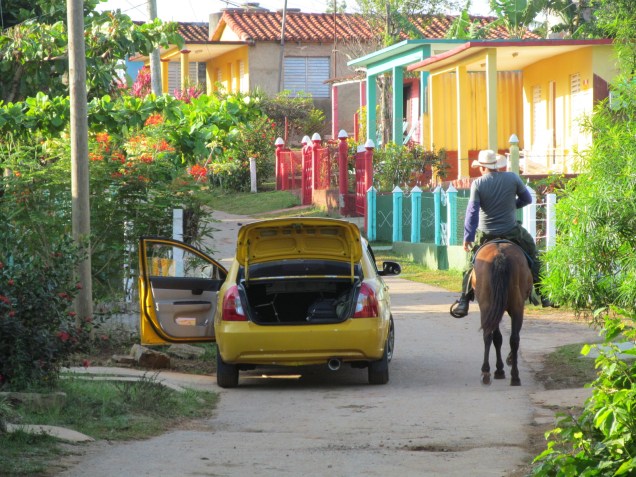 Cowboy in Cuba by Kimberly Hirsh
Tip #4: Go small. I’ve been doing that more and more as I cover more traveling miles and countries. I find I just don’t need stuff any more. But I do like to support local artisans and a little keepsake brings joy. This was my most recent:
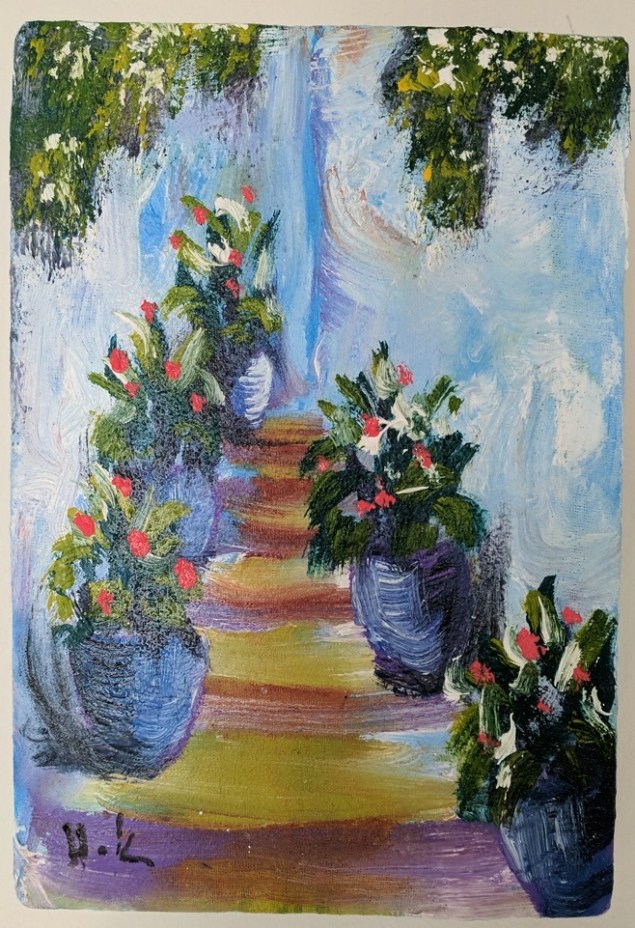
The magical blue city of Chefchaouen, Morocco
This painting is TINY – a mere 5.5 inches x 8 inches. I brought it home on the stretchers since it was small and light. I popped one nail on a narrow wall in my bathroom and done! Frame not necessary.
Note: I HIGHLY recommend Chefchaouen! You could take photographs for days and not want to leave.
My Klimt-esque piece from Barcelona is another tiny one:
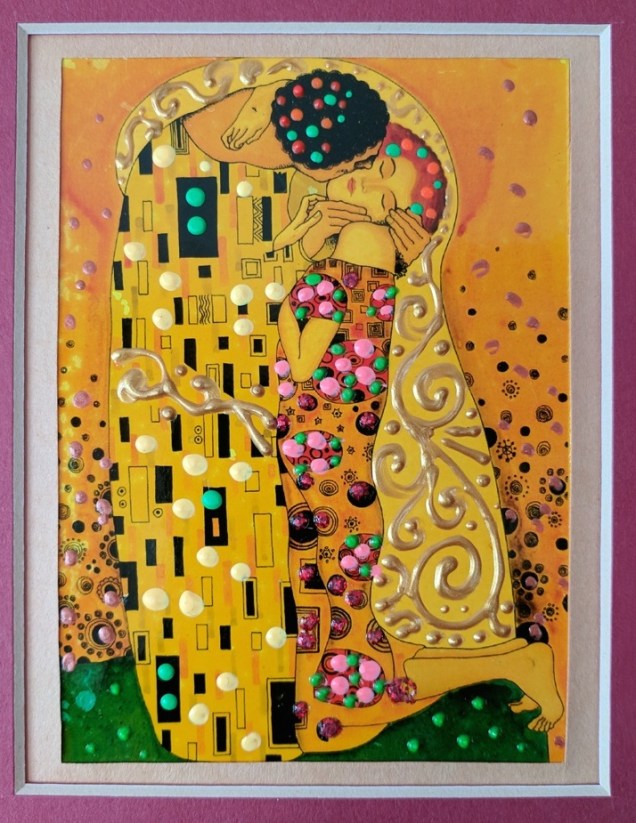
I bought this at a stand on the Passeig de Gràcia, a main strolling street. It fit perfectly in a standard mat (you get a glimpse of the red) and framed to 5×7 inches, both purchased at home in the U.S. I’m not sure if you can tell from the photo that that the piece mixed media, meaning all those dots appear glued on and maybe laquered over and the gold curlicues are raised. I love this tiny thing so much (I mean, who doesn’t love Klimt?), I went back a couple years later hoping the artist would be there so I could buy some more. He was not.
Lesson: when you see something small and inexpensive that you love right away, buy it right away. There are few things that you will ever remember and regret passing on, but art is one of them.
 WhyTravel