Leading up to my trip to Lilongwe, Malawi, I was anxious for a number of reasons. It was my second trip to Africa and I had spent the first one typing in a hotel room on a dial-up internet while my team leader, a Zimbabwean doctor, took the other (male) team members to tour various health projects. My team leader for this second trip was Issakha, a Senegalese epidemiologist whom I had never met. We had a lot of work to accomplish in our two weeks together.
Issakha flew in the day after I arrived. When I met him in the hotel lobby, I could tell this trip would be different. Issakha towered over my small frame, but looked me straight in the face as he grasped my hand warmly. When the professional soccer teams started arriving at the hotel for the Africa Cup, he would watch over me with a fatherly eye.
The following day, we set off with a group of colleagues to visit a district hospital. Within minutes, we left the small capital’s city limits and soon after the paved roads disappeared into dirt.
The hospital was a two-hour drive along high grasses and thin trees. I was excited to see some effects of the work I had been doing from an air-conditioned office in the U.S. Our project in Malawi was helping to renovate a pediatric wing of the hospital. The project was nearing its end and we had found some extra funds. At headquarters, we had considered paying them out as salary to our employees in Malawi, but instead, the Lilongwe office had asked that we use the funds for the hospital. When I announced the decision to the employees in the office that morning, they broke out into applause. It choked me up and I waited awhile before speaking again. I expected to see such generosity again in the future while working in the public field, but did not. I also would find that men as caring as Issakha are rare. I got lucky.
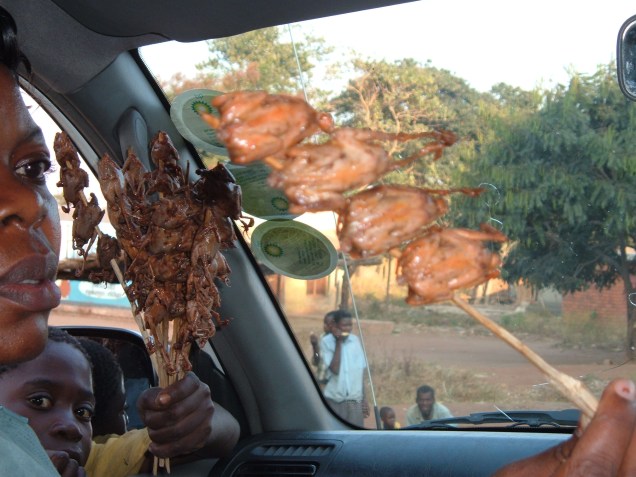
Kids selling roasted birds on skewers through our car window
When we arrived at the hospital, our driver pulled our white four-wheel-drive vehicle into the circular dirt drive. The low buildings sprawled over a large area. Random wings protruded from the central building encompassing courtyards of grass and dirt.
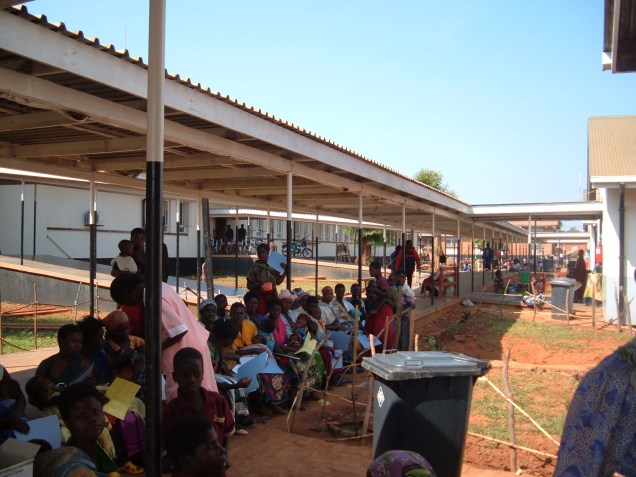
Hospital services are delivered outside and inside.
I was told that the children’s wing was tiny and unequipped. Still, I was unprepared for what I saw when I stepped out of the air-conditioned SUV. My long linen skirt fluttered in the breeze. Simmering stew scented the air.
The hospital director greeted us warmly and led us to the wing that held the new pediatric ward, as yet unoccupied. There, he introduced us to the head of the pediatric department. They both beamed with pride. The cement floors were completed, the walls were up. The wooden roof was still open, and cabling had begun for electricity.
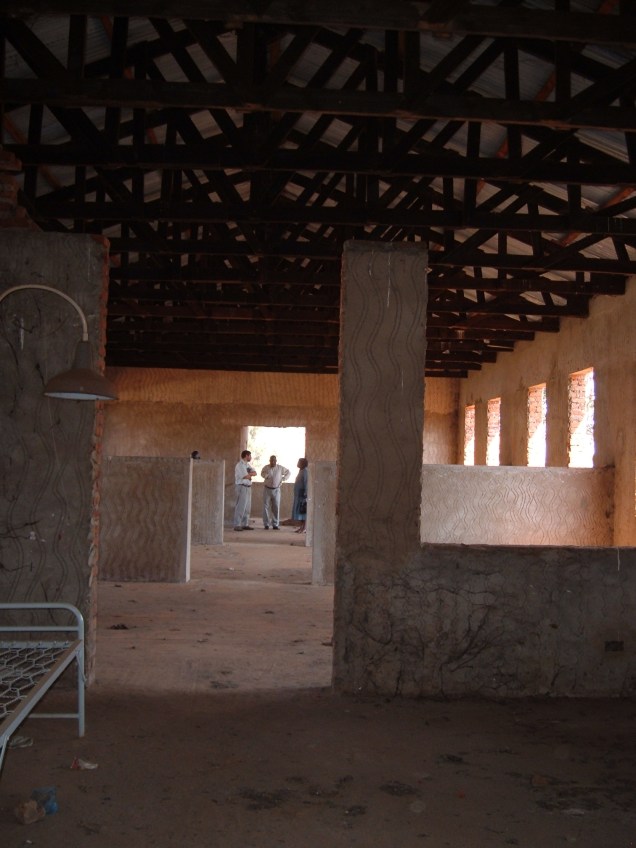
The new pediatric wing under construction
Rudi, our project director in Lilongwe, told them that we would have more funding for the pediatric wing. They gasped with delight and hugged all of us.
From there, we returned to the main hospital building. At the entrance to the existing pediatric ward, we stepped over children sleeping in the hallways. The children’s ward had seven beds, but they were empty. Forty or fifty children sat on cement floors, outdoors, where there was no roof. An open sewer for gray water ran along the walls to its terminus, also open, around 50 feet from the building. The terminus had been recently upgraded.
Where the cement floors ended, the courtyards began. Here, there were families camped out, cooking, washing laundry in plastic tubs. In addition to the people, there were chickens running around and a few goats grazing.
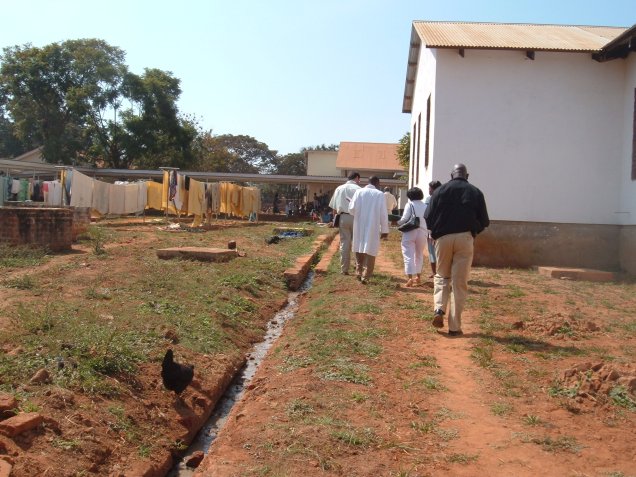
The chicken on the left joined part of our tour.
“The families live on the grounds of the hospital however long they need to,” the director said. “There is not enough staff to care for the kids overnight, so their mothers take care of them.”
As we returned to our car out front, oxen were parked in the driveway, calmly waiting their owner’s return. We thanked the staff, waved goodbye, and drove around the oxen.
That weekend, I took a trip to Liwonde National Park. The employees in my office urged me to take a private car, but I insisted on the bus. The local buses were equivalent to a Volkswagen minivan, but with moving seats and twenty-five people shoved inside. The ride took four hours with people constantly climbing on and off, and rearranging people and their packages to fill it all. A woman boarded holding a baby on her hip and a guinea fowl by its wings. As she got settled, she would hand the bird to different people. At one point, she ended up sitting next to me. I gave her a look that said don’t even think about handing me that thing and it worked.
Liwonde National Park for me was like finding a new religion, so I was ebullient when I boarded the bus at the end of the weekend to return to the city. On the boat into the heart of the park, I had seen hippos and elephants. My cabin at Mvuu Lodge opened to a lagoon and a crocodile floated by my terrace. Hiking, I had spotted warthogs eating while on their knees (they’re my favorites), monkeys with bubble-gum-blue balls, baboons, impalas, kudu, sables, waterbuck, and zebras. From the dining room, we watched herons, storks, and rainbow birds in flight.
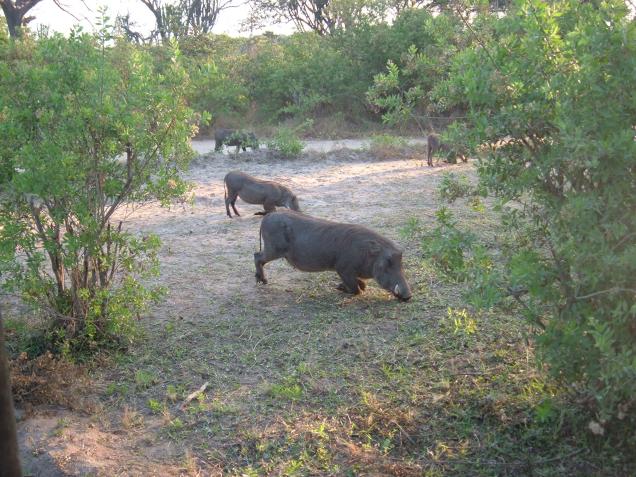
The underappreciated warthog
On the bus ride back to Lilongwe, I sat next to a different type of passenger. He was a man in his twenties, holding a boy of maybe five, slumped against his shoulder.
“What is wrong with him?” I asked, before sitting next to him. I was worried that he might be contagious.
“Malaria,” the father said. “I am on my way home from the hospital.”
The boy was lethargic and barely responsive. I watched him drift in and out of sleep. I wondered what they did for them at the hospital, how long he’d waited, and how much money it had cost him. I pictured the hospital I had just visited, my first, the scene I will never forget. The kids and mothers in labor on the cement floor, the families hanging their laundry on lines. I hoped they had medicine where the father took his son. I hoped they’d hydrated him. It did not look it. If they did, I hoped the needle was sterile.
At a stop, the father got up. There was a small stand selling bottled drinks, American brands. I handed him the kwachas I had, probably five or six dollars’ worth.
“Orange juice, not coke, ok?” I looked the man straight in his face. As he carried the limp boy off the bus, I was still pleading, “orange juice!”
Everyone on the bus thanked me and called me “sister” for the rest of the ride. As people got on and off, they made sure there was room for my bum on the rickety seats. They stood to help me and my bags off the bus when it was my turn to exit and we waved goodbye.
Dear Reader, if you have not taken a safari, you should take one in your lifetime. If you have not toured a health facility like the ones that the vast majority of the planet has access to, you should. Finally, when you travel, always talk to people, listen to them, engage. Tell them stories about your life. Bring photos of your family and show them to people. Ask lots of questions. People love to share and to learn about you.
 WhyTravel