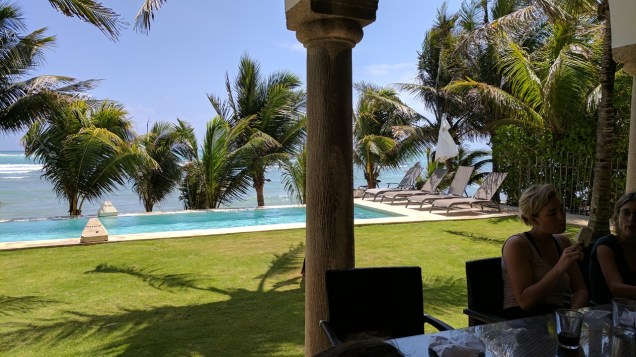
It was one of those moments in life where you can’t believe your own fortune. The company I was working for was having its annual retreat. This year, it was in Playa del Carmen, midway between Cancun and Tulum, on Mexico’s lovely delft-blue Yucatan coast.
It was Saturday night and my co-workers and I had been drinking from pitchers of margaritas that the villa staff whizzed up before they departed each night. We had worked late, as we did each night on that retreat. The pitchers of margaritas came out around five each evening and we continued on with our business. I slipped away for an hour to my room. I had to call Boston to conduct a moderately drunken phone interview. I liked the candidate and so I was rather buoyant as I skipped down the stairs to re-join the group in the lounge area.
It was the second time in my years working for him that my boss looked at me and said, “What the fuck happened to your face?” Yatesh was not known for his diplomacy.
“Are you fucking kidding me?” My left hand reflexively shot up to my face, as if I could find the violation, feel it.
Granted, the first time Yatesh employed that exact phrase, four years earlier in Dhaka, my face was a mess. I could not see the mess in the mirror because I was literally blinded by a headache that put me in bed for four days. The only thing that got me up was to use the bathroom. I was eventually rescued by a team of friendly colleagues and strangers.
This time, the second, I was at a beautiful private villa in Mexico, on the beach in Playa del Carmen. But my face. Again?
“WHAT? WHAT?!!” I was panicking. I was ready to shake Yatesh to force his normally-hyperactive-but-now-flaccid mouth to resume moving.
“Your eye. It’s bleeding.” Yatesh was calm and it was not helping, but at least now I had a location.
I jumped up, tripping out of the bay of sofas, chintz pillows, and potted plants, to scurry around the corner to the bathrooms. Ok, I thought, at least this time I can see. My mind raced. Is there a doctor? A hospital? A competent doctor? There’s gotta be competent doctors in this tourist town, I thought.
This was my fourth incident. My first eye crisis was in Rwanda six years earlier. A few months later, on the island of St. Lucia. And that truly horrible time in Dhaka. Four times in the past six years. Maybe decades of travel were catching up with me. Maybe it was time to stop, I thought. Maybe Playa del Carmen has a twenty-four-hour hospital.
But back to Mexico. In the ocean blue talavera-tiled bathroom, I took some time to scrutinize my eye in the mirror. Of first note, it was my left eye. I had a cornea transplant in that eye and it was a constant worry for me, rational or not. I reconsidered my initial embarrassment at the thought of seeking medical attention. This is Playa del Carmen, I thought. These doctors would have seen injured drunk tourists before.
What had happened in Rwanda six years earlier was some pain in my left eye, but not panic. I consulted with my co-workers, who gave me the phone number of “the President’s ophthalmologist”. The doctor ushered me into her clean, modern, equipped office the next day. My problem was minor and she prescribed eye drops.
In St. Lucia, on a work trip, I woke up one morning in my room in a lovely inn fronted by a lily-filled lake. I rolled out of bed in shorts and a T-shirt and without getting properly dressed, went downstairs to say goodbye to my coworkers who were checking out at the front desk. My flight was leaving later that afternoon. I still had sleep in my eyes. Michael, my supervisor on that trip, was no less of an asshole than Yatesh, but more diplomatic in his delivery.
“Um, there’s something happening with your eye,” he said. Michael did not usually even look in my direction, never mind in my eyes.
“Really? What do you mean?”
“Well, it’s kind of red.”
“How red?” I asked and started touching my face, as always, when I become concerned.
“You should go look in the mirror.”
I did not catch my flight that afternoon. Instead, I spent the morning making phone calls to find an eye doctor who would see me (it was a Saturday, again, of course) and the afternoon sitting in his waiting room. After all his patients for the day were gone, he took me into his office. My eye, he reassured me, was not a problem. He said he had done a rotation at Mass Eye and Ear in Boston (my own hospital at home). No, I did not need any drugs or special treatment, he explained.
When I got home a week later and went in to my doctor’s office, the resident there told me what I had was a “rejection incident.” Had I been briefed previously on even one or two of the symptoms, I could have figured that out, without a medical school degree.
Two years later, in Dhaka, Bangladesh, was a serious web of problems that requires its own story. For now, I’ll just say that the illness delayed my return home at the end of a very long assignment. The doctor said I could not fly.
Meanwhile, back to Mexico and the present…
It took several minutes for my brain to process that I was traveling with an actual Boston-based medical doctor. I had worked in public health for more than a decade, but had come to expect the doctors I traveled with to be useless, hopelessly out of date, loathe to touch patients, or some combination of the aforementioned. (Bennett had actually recoiled with an “Ichkk!” when I merely asked him to look at the rash that had broken out on my neck while we were in Ethiopia.) However, this was an actual, real doctor. When he wasn’t consulting on research projects for my company, Nadeem did shifts at the E.R. in one of the busiest hospitals in the city.
Nadeem was not afraid to touch me and he was completely calm. Turns out, he knew something about eyes from medical school and experience.
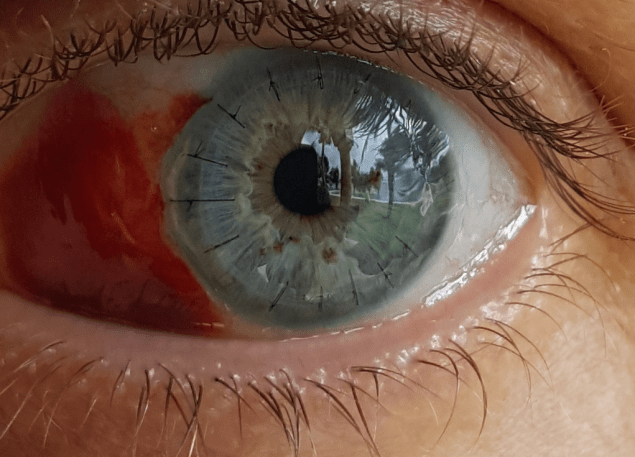
Nadeem said, although I looked like an alien from Village of the Damned (ok, I said that, not him), it was perfectly harmless. He called it a sub-conjunctival hemorrhage and said it had no involvement with my cornea implant. I know vaguely that these such hemorrhages are nothing, but I was still shaking.
He knew what it was, but he humored me in the most lovely way by continuing to look and peer and examine my eye from every possible angle and compare it with my unaffected right eye. He even suggested photographing it and sending the pictures to my ophthalmologist back home.
Phones have cameras and the villa had internet. Brilliant. I never thought of this in my state.
After snapping a few photos and emailing them off to my doctor, it was time to return to the margarita pitchers. My hand was still trembling nervously as I held the cocktail glass.

Two years later, back in Boston, I sat down in the patient’s armchair in my ophthalmologist’s office for a regular check-up. She travels some, but she always asks me about my most recent destinations. She wants to hear about my adventures to live vicariously. From my end, I would have preferred not to be on some of these trips.
During the two years that had passed, I changed jobs and took a role that allowed me to work nearby home. I had multiple eye doctor appointments. I took vacations to Morocco (where my left foot swelled up) and South Africa (where no health events happened). I forgot about Playa del Carmen and even public health was already fading.
Dr. Ann reminded me of the hemorrhage.
Was that me? This was my typical reaction to two years and a lifetime ago.
Ann told me she was delighted by the photos I had emailed her Mexico. She had set one of them as her desktop background on her office computer. She had been gazing upon it for two years now.
My eye?
She misinterpreted my surprised expression and quickly jumped in to say she hoped that I did not mind. No, I laughed, I did not mind at all. She said it had nothing to do with the bleed. When she had opened my photos on her computer screen, what she saw in Nadeem’s zooms of my eye was the reflection of palm trees and the sea.
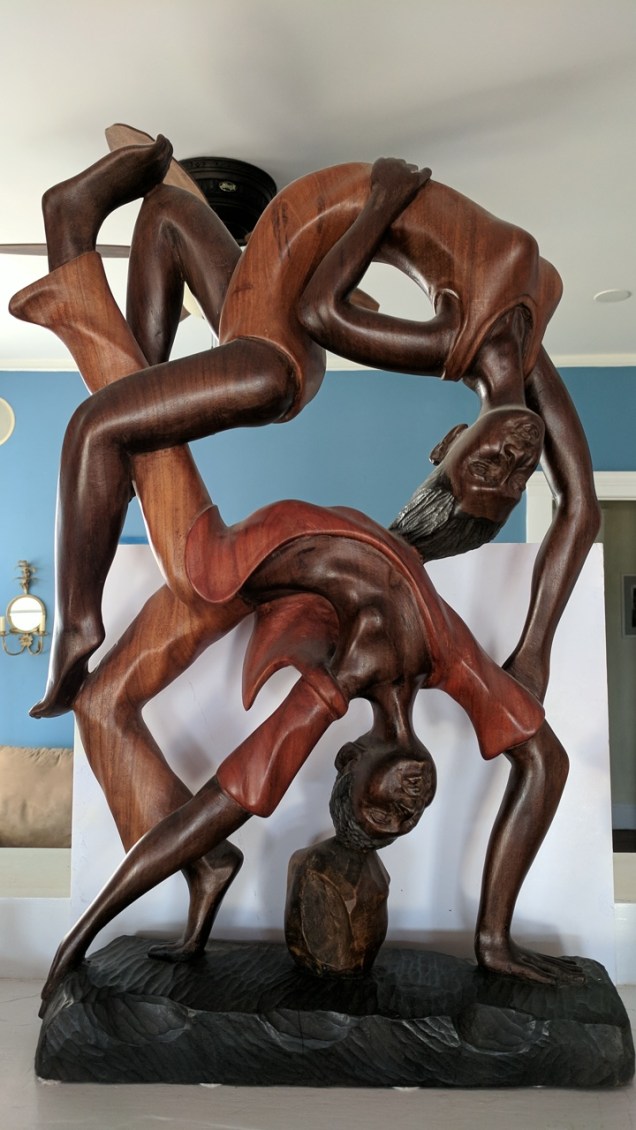 I went into this shop looking for a small wooden carving of a couple. A couple of weeks later I came out with this sculpture of Les Danseurs. It is rather large. I should clarify that I did not carry it home myself. I was on a work trip and the artist told me he would be done in 1 week. He was not and I had my flight out. Luckily, another colleague from the U.S. stayed behind and he generously picked it up and transported it. I was expecting a tchotke, not a sculpture. Sean had to buy it its own new gym bag to get it back. Thank you, Sean 🙂
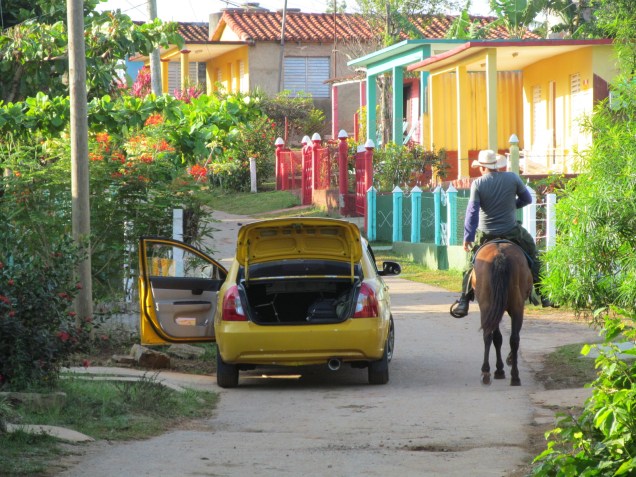 Cowboy in Cuba by Kimberly Hirsh
 WhyTravel